
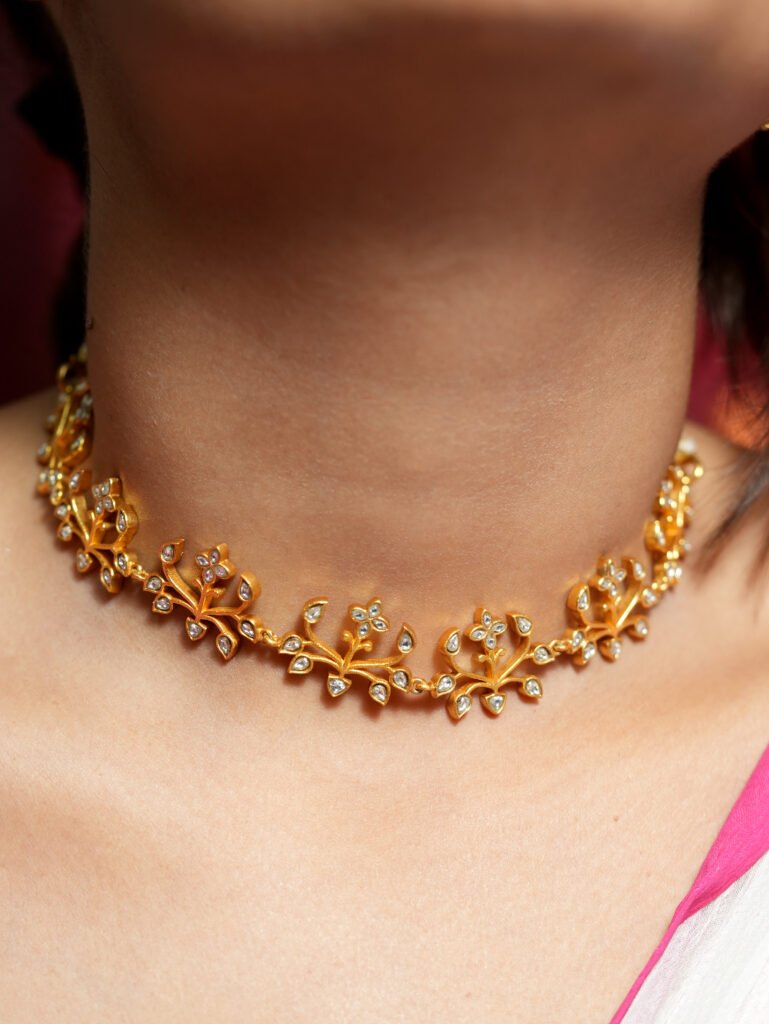
Customers use these three words as if they mean the same thing. They don’t, and a store owner who can explain the difference sells with more confidence.
Jadau is the technique
Jadau is the traditional craft of setting stones into metal without prongs. The stone is pressed into the setting and held by metal worked around it. It is the method, not the stone.
Kundan is the setting style
In kundan work, each stone sits in a frame and is held by fine foil pressed around its edges. Traditional kundan uses glass or gemstones with a coloured foil behind them, which gives the rich reds and greens buyers love. So a kundan ruby or emerald is usually not a natural ruby or emerald: the colour comes from the foil. That is what keeps kundan affordable.
Polki is the stone
Polki means uncut, unfaceted diamonds, set in the same traditional style. Real diamond polki in gold is expensive. Today many pieces use moissanite cut flat to give the polki look at a fraction of the price, and these should be sold as moissanite polki.
In 925 silver
All three looks are made in 925 sterling silver with gold plating. You get the weight, feel and finish of traditional jewellery at a price your customers can reach, and you can tell them exactly what they are buying.
How to explain it at the counter
- Jadau: how it is made
- Kundan: stones with foil, rich colour
- Polki: uncut diamond look, natural or moissanite
We make kundan, jadau and moissanite polki jewellery in 925 silver in our own Jaipur workshop. For wholesale, WhatsApp 088248 91530 for a live video call. Minimum order 500 g.
